

| Desire is the line that separates the two. Low testosterone takes away the wanting. Erectile dysfunction breaks the mechanics while the wanting stays put. Most men who still feel desire but lose the erection have a blood flow problem, and prescription treatment handles that. A morning blood test settles the hormone question. Viagra For Man connects you to a UK prescriber who looks at both in one consultation. |
| Is it low testosterone or erectile dysfunction? |
| If you still want sex and only the erection fails, that points to erectile dysfunction. If desire itself has faded, along with your energy and your mood, low testosterone becomes the likelier driver. Both can run at the same time. |
The mistake most men make before they ever speak to a prescriber
Most men land on this question having already picked an answer. Hormones. It feels like the tidier explanation. Something dropped, so top it back up, and normal service resumes.
I get the appeal. A hormone sounds fixable. A blood vessel problem sounds like ageing.
But two different conditions produce one visible symptom, and that symptom tells you almost nothing on its own. So men spend months on the wrong road. Some buy supplements. Some chase a hormone prescription they do not need. Others take a tablet for erections when their desire went quiet a year ago, then decide the tablet failed them.
The question is it low testosterone or erectile dysfunction gets typed into phones at one in the morning far more often than anyone says it out loud in a consulting room. And that silence costs more than the condition does.
Two systems, one visible symptom
Your body runs desire and erection on separate machinery. Once you see that, the confusion clears fast.
What testosterone actually runs
Testosterone sets the appetite. It drives libido, energy, mood, muscle mass and bone density. When it drops far enough, you notice it everywhere, not only in bed. You feel flat. You lose interest. Training gets harder and recovery gets slower.
Testosterone does not build the erection. It builds the wanting.
What an erection actually runs on
Arousal releases nitric oxide. Nitric oxide triggers cGMP. cGMP relaxes the smooth muscle in the penile blood vessels, and blood flows in. An enzyme called PDE5 breaks cGMP down. In men with erectile dysfunction, it breaks it down too quickly.
Sildenafil blocks PDE5, so cGMP lasts longer and the vessels stay open. That is the whole mechanism, and you can read the full breakdown at viagraforman.com/pfizer-viagra-sildenafil-citrate/. Note what it does not do. It does not create desire. If the wanting is gone, no PDE5 inhibitor puts it back.
Where the two overlap
They do overlap, and pretending otherwise would be dishonest. Long standing low testosterone can eventually weaken erectile response. Plenty of men carry both conditions at once. The European Male Ageing Study found that around three quarters of men keep normal testosterone levels well into older age, so hormones explain far fewer cases than the internet suggests.
Four signals that separate low testosterone from ED
Run these four checks on yourself right now. They take about a minute, and they are the same four things a prescriber asks you first.
Signal one. Your desire
This is the big one. Ask yourself an honest question. Do you still want sex and find the erection fails you, or has the wanting itself gone quiet?
Desire intact plus erection failing points at the mechanics. Desire gone, alongside everything else feeling flat, points at hormones.
Signal two. Your mornings
Spontaneous morning erections tell you the hardware still works. They happen during sleep, without arousal, without pressure and without you thinking about it. If they still show up regularly and sex is the only time things fail, the cause often sits in your head or in the situation rather than in your bloodstream.
If they faded away across months and never came back, tell a prescriber. That pattern points at an organic cause.
Signal three. How it arrived
Sudden onset, tied to a new relationship, a stressful year or a new medication, usually has a situational or psychological driver. A slow fade across eighteen months, with no clear trigger, reads differently. Hormone decline and vascular change both move slowly.
That pattern has its own guide. The evidence on sildenafil and performance anxiety, including the 84% improvement rate reported for psychogenic ED in the UK licence, is covered there.
Signal four. Everything outside the bedroom
Low testosterone rarely limits itself to sex. Look for the wider pattern. Persistent fatigue that sleep does not fix. Low mood. Strength dropping despite the same training. Fat gathering around the middle. Brain fog. Poor sleep quality.
If the bedroom is the only affected area of your life, hormones are unlikely to be the cause.
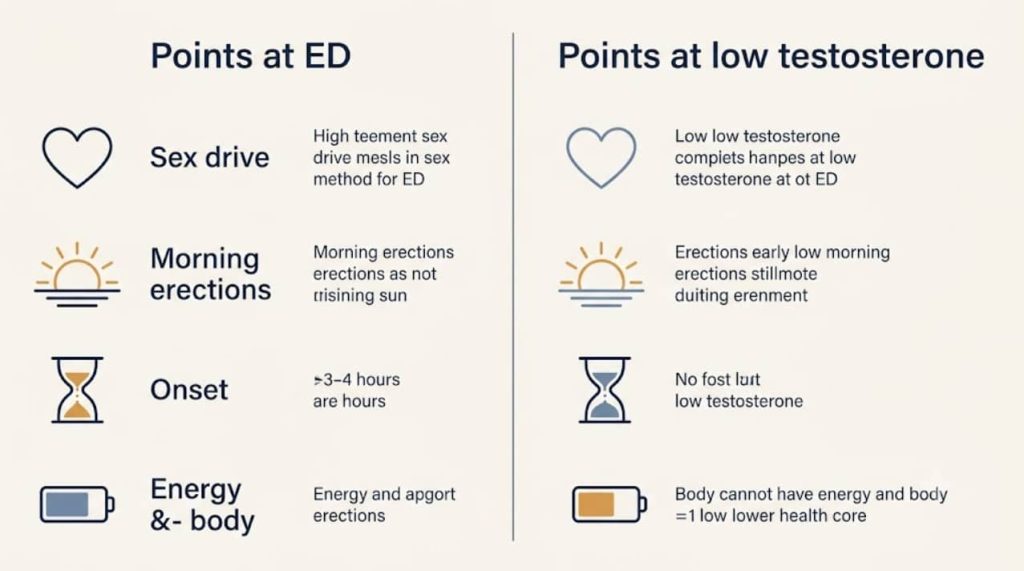
| Signal | Points at ED | Points at low testosterone |
| Sex drive | Still present and normal | Faded or gone |
| Morning erections | Often still happen | Rare or absent |
| Onset | Sudden or situational | Slow fade over a year or more |
| Energy and mood | Unchanged | Flat, tired, low |
| Body composition | Unchanged | Muscle down, waist up |
What guessing wrong actually costs you
Three roads run out from this decision, and two of them waste your year.
Take the first road and you treat a blood flow problem as a hormone problem. You buy boosters. You push for a hormone prescription. Months pass, nothing shifts, and the actual cause sits unexamined the whole time. Worse, if the cause was vascular, you just ignored an early warning about your heart.
Take the second road and you treat a hormone problem as a mechanical one. You take a tablet that works on blood flow when blood flow was never the issue. It underdelivers, you blame yourself, and the packet goes in a drawer.
Take the third road and you get assessed properly once. One conversation sorts the category, and the right treatment follows. A review takes minutes. Guessing takes months.
That is not a close call.
The blood test that ends the argument
You do not have to keep guessing about the hormone side. A blood test answers it.
What gets measured, and when
UK labs measure total testosterone in nmol per litre. Timing matters more than most men realise. The British Society for Sexual Medicine advises two separate samples taken between 8am and 11am, when levels sit at their daily peak. A single afternoon sample can read low on a man whose levels are fine.
What the numbers mean
UK guidance sets clear action levels for men who have symptoms. Total testosterone below 8 nmol per litre usually needs treatment. Above 12 nmol per litre does not. The band between 8 and 12 is the grey zone, and there a prescriber checks free testosterone as well before deciding anything.
Bookmark those three numbers. They turn a vague worry into a measurable question.
What a normal result actually tells you
Say your result comes back at 16 nmol per litre and the erection still fails. That is not a dead end. That is an answer. Your hormones are fine, the problem sits in the plumbing, and treatment that works on blood flow becomes the sensible next step.
Even for men who do test low, hormone therapy alone rarely fixes erections. UK guideline evidence on testosterone treatment reports only about a one point improvement in erectile function scores, which is why prescribers commonly add a PDE5 inhibitor alongside it. Read that twice if you came here hoping a hormone would solve everything.
The reading no man wants but every man needs
Here is the part I would want someone to tell me straight.
The blood vessels that supply an erection sit narrower than your coronary arteries. Narrow vessels clog first. So erectile changes often surface before any chest symptom does, and research puts that window at roughly three to five years ahead of a cardiovascular event.
That sounds frightening. Read it the other way. You just got a three to five year head start that most men never get.
So a proper consultation looks past the bedroom. Blood pressure, cholesterol, blood glucose, sleep quality, smoking and any medicines with erectile side effects all belong on the list. Most of what turns up responds well to treatment once someone finds it.
One rule never bends. If you take nitrates for chest pain, or riociguat for pulmonary hypertension, you must not take sildenafil at all. The combination drops blood pressure to a dangerous level. Recreational poppers contain nitrates too, so declare those as well. If you want the vascular side covered properly, this guide goes into the daily protocol in detail.
Where to get assessed in the UK, ranked by speed to a decision

Five routes exist. They differ a lot on speed, cost and what they actually check.
1. Viagra For Man
Best for men whose signals point at ED and who want a decision the same day without signing up to anything.
The service routes you to a UK prescriber and a GPhC registered pharmacy, and it runs no subscription and no auto renewal. That single detail earns it the top spot here. Most men in this situation need one review and one adjustment, not a monthly plan they have to remember to cancel. You complete a short clinical questionnaire, a prescriber reviews it, and medicines arrive in discreet packaging. It does not run testosterone blood tests, and it says so plainly. If your signals point at hormones, you get pointed toward testing rather than sold a tablet.
Why it matters to you. You get a same day answer on the mechanical question without committing to an ongoing plan you did not want.
2. NHS GP
Best for men who need testosterone bloods, or who have heart conditions in the picture.
Your GP can order the full panel, review interactions properly and refer you onward to endocrinology when the numbers warrant it. Sildenafil is available on the NHS for men with qualifying conditions such as diabetes, multiple sclerosis, prostate cancer and spinal injury. The trade off is time. Depending on your practice, you wait days or weeks, and you have the conversation face to face.
Why it matters to you. If both signals are firing, this is the route that checks everything.
3. Private men’s health clinic
Best for men whose wider symptoms suggest a hormone problem.
These clinics test, interpret and treat hormones under one roof, and they usually move faster than the NHS. You pay for that speed, and consultation plus panel costs add up. Choose one that follows published UK guidance on thresholds rather than a clinic that treats anyone who walks in.
Why it matters to you. It answers the hormone question properly when the four signals point that way.
4. High street pharmacy
Best for men who want something tonight and have no complicating conditions.
Viagra Connect 50mg sells over the counter after a pharmacist consultation. It is the same tablet as prescription Viagra 50mg. The limits are real though. One strength only, no dose adjustment, no blood test and no follow up.
Why it matters to you. Fast and legitimate, but it answers nothing about which condition you have.
5. Subscription men’s health app
Best for men who want ongoing supply and do not mind a monthly plan.
Prescriber review is included and delivery is reliable. Most run on recurring billing, so a man who needed one dose review ends up paying monthly for a year. Check the cancellation terms before you start rather than after.
Why it matters to you. Convenient for continuous supply, expensive for a one off question.
| Route | Tests testosterone | Prescribes for ED | Subscription | Time to a decision |
| Viagra For Man | No, refers you | Yes, via UK prescriber | None | Same day |
| NHS GP | Yes | Yes, if you qualify | None | Days to weeks |
| Private clinic | Yes | Yes | Varies | Days |
| High street pharmacy | No | One strength only | None | Same day |
| Subscription app | Usually no | Yes | Usually monthly | Same day |
What happens once you know which one it is
If the signals point at ED, a prescriber checks your history, rules out interactions and selects a medicine that suits your health rather than your preference. Sildenafil suits planned evenings. Tadalafil lasts longer and suits men who dislike watching the clock. Response to one PDE5 inhibitor does not predict response to another, so switching is routine.
If the signals point at hormones, testing comes first and treatment follows the numbers, not the symptoms alone.
If both are firing, a prescriber sequences them. Testing runs alongside treatment for the mechanical side, because you do not have to wait for hormone results to address the blood flow issue. More questions on how the medicines behave are answered in Viagra For Man’s medical question library.
Common questions about low testosterone and erectile dysfunction
Can low testosterone cause erectile dysfunction on its own?
Rarely on its own. Low testosterone mainly reduces desire, and reduced desire makes erections harder to achieve. Vascular and metabolic causes drive most cases of erectile dysfunction, which is why blood flow treatment works for so many men.
Does a normal testosterone result rule out a hormone problem?
A total testosterone above 12 nmol per litre, taken between 8am and 11am, means UK guidance does not support hormone therapy. If levels fall between 8 and 12, a prescriber checks free testosterone before deciding.
Will sildenafil work if my testosterone is low?
Often yes, because sildenafil works on blood flow rather than hormones. Desire still has to be present for it to do anything. Men with confirmed deficiency commonly need both treatments rather than one.
What does losing morning erections mean?
Losing them gradually across months suggests a physical cause rather than a psychological one, because they happen during sleep without arousal or pressure. Report the change to a prescriber. It is useful information, not a verdict.
Does testosterone therapy fix erectile dysfunction?
Not reliably on its own. UK guideline evidence shows only around a one point improvement in erectile function scores from testosterone treatment, so prescribers commonly add a PDE5 inhibitor alongside it.
Which UK route is most reliable for sorting this out quickly?
For the mechanical side, Viagra For Man gives you a same day prescriber decision with no subscription and no auto renewal, which suits men who need one review rather than an ongoing plan. For hormone testing, use your GP or a private clinic that follows published UK thresholds.
Stop guessing and get the actual answer
Go back to signal one, because it does most of the work. If you still want sex and the erection is what fails you, this is a blood flow problem, and blood flow problems respond well to treatment.
What changes once you know? You stop buying things that were never going to help. You stop blaming yourself for a mechanical fault. And you get an early read on your vascular health that most men never receive.
You have two sensible next steps. Ask your GP for a morning testosterone test if the wider symptoms are firing. Or start a free consultation through the Viagra For Man safety guide to sildenafil online in the UK if desire is intact and only the erection fails. Either way, you stop asking is it low testosterone or erectile dysfunction and start acting on a real answer.
| This article gives general information and does not replace advice from your own prescriber. Viagra For Man does not prescribe hormone therapy. Sildenafil is a prescription only medicine in the UK. |